Merry Christmas to all our friends and family! What's Christmas all about anyway? No-one says it better than Linus . . . click below for an excerpt from our favourite Christmas program of all:
Thursday, December 25, 2008


Thursday, December 18, 2008
Couchsurfing

A new verb has been born: couchsurfing. When I first heard of this phenomenon last year, I was intrigued. When I tell others about it, they are skeptical at best and repulsed at worst. Couchsurfing is the verb coined to describe a network of people who share free accommodations internationally. The main website is couchsurfing.com. When you peruse this site, you will read somewhat lofty explanations of their mission. The founders discuss ideals of their "Couchsurfing Project" such as creating educational exchanges, raising collective consciousness, spreading tolerance and facilitating cultural understanding. But for the majority of people, I suspect it's mostly about getting free accommodations.
It works like this: you register as a member on the site, offer some level of hospitality to other travellers (ranging from meeting for coffee or to show visitors around, all the way to offering up a room in your home to various vagabonding strangers). And then when you are the traveller in a strange land, you too can search for an available "couch" and make those international connections. I actually like the idea in theory. I think most people would have a far better and more memorable experience of a new country if staying with locals. The biggest stumbling block most people have, including my dear husband, is of course the issue of safety.
Not surprisingly, the site cautions people to use common sense, especially women travelling alone. The Couchsurfing Project has instituted some measures to help reassure people. For instance, members can be "vouched for" as well as "verified". Verification simply means the member has paid a small fee to have their physical address verified. Vouching refers to a testimonial by another couchsurfer who has met you face-to-face and deems you trustworthy.
As of today, the site reports that over 800,000 people from 230 countries are participating in couchsurfing. There are also sub-groups within the couchsurfing community and this is where it gets very interesting. I checked out the "Family Welcome Group" naturally since I reasoned one could probably feel relatively safe if staying with another family. The "RTW" group also caught my eye. But the sub-groups get incredibly specific and bizarre. For example, you can search for a free couch among "vampire lovers', "chocolate lovers", "Calvin & Hobbes" afficiandos, "Harry Potter fans", "vegan raw foodies", "people who don't need drugs or alcohol to have fun", "50+ travellers", "the David Hasselhof appreciation group", "barefooters", "SpongeBob fanatics", "single parents of many children" or how about the "people who enjoy silence" group. Better not mix those last groups together. I'm being a bit facetious. There are also plenty of perfectly normal groups like "engineers without borders" or people wanting to practice a specific language.
When I floated the idea to Ted (in truth I went a bit further and actually created a profile for us), he reacted with something close to horror. No way, no how. Oh well. That's what the delete button is for, right? Still I do hope we are able to connect with families who are native to the countries we'll be visiting, and not just other tourists. I also think it would be good for our kids to have the chance to meet international visitors staying here in our own home from time to time. And a free place to stay once in a while on our trip wouldn't hurt either . . .
Saturday, November 29, 2008
Grannies a Gogo

If you've been following this blog, you will see a new addition in the Links section. I've added the website for Grannies a Gogo. My sister Sue is the founding member and chairperson of this group of "grannies" from Vernon, BC who have connected with gogos (the word for grandmother in Zulu) in Sabie, a village in rural South Africa.
From 2001 to 2005, Sue and her husband Ken lived in Sabie but have now moved back to Vernon. They continue to make regular trips back to see the friends and offer encouragement with projects they were involved in during their time there.
The gogos in Sabie have many things on the go, not the least of which is raising their AIDS-orphaned grandchildren. The Grannies website notes that there are an estimated 2.5 million AIDS-orphaned children in South Africa alone.
I have really been enjoying Sue's blog within the site and I would encourage you to check it out as well. Her posts are quick snippets of what's happening with the group, now that she's over there for a visit. I am inspired by her posts and by her writing as well. As usual, the little sister could learn a thing or two. Don't be so wordy . . . keep it short and snappy.
Monday, November 17, 2008
One Smile at a Time
 One goal I have for myself in our year away is to take part in an Operation Smile medical mission. Operation Smile is a private, not-for-profit medical services organization that travels to developing countries to repair cleft lips, cleft palates, and other childhood facial deformities. I first heard of this organization years ago as a speech pathology student in Toronto. It always seemed like it would be an exciting and rewarding volunteer experience. Next year, if everything lines up as I'm hoping, this dream could become a reality.
Operation Smile was founded by Dr. Bill Magee, a plastic surgeon, and his wife, Kathy, a nurse and clinical social worker. In 1982, the Magees traveled to the Philippines with a group of medical volunteers to assess and surgically repair children's cleft lips and cleft palates. They encountered far more children suffering from facial deformities than were equipped to deal with on that trip. They were forced to turn many children away but rather than succomb to discouragement, they took stock of the enormity of the need and founded Operation Smile.
Cleft lip or cleft palates occur in approximately one out of every 700 live births. In the western world, corrective surgery would occur within months of that infant's life. But in developing countries, these children can live for years - sometimes even into adulthood - with unrepaired clefts. The consequences to their ability to eat and to speak are obviously very signficant. In some cultures, these kids will be hidden away by their families because of rejection by their villages due to a lack of understanding of the condition.
Since 1982, more than 120,000 children have been treated by thousands of volunteers in Central and South America, Africa, Middle East, Eastern Europe and Asia and thousands of healthcare professionals have been trained globally. According to their website, Operation Smile now have a presence in 51 countries. Operation Smile builds in sustainability and capacity-building by coming alongside professionals in these developing countries and offering education and training. Mission-based education ranges from full-scale medical conferences to informal workshops on a specific skill or technique.
Each medical mission is compised of a team that includes a plastic surgeon, anesthesiologist, pediatrician, pediatric intensivist, biomedical technician, speech pathologist, child life specialist, dentist and nursing staff. Each medical volunteer has to be credentialed by Operation Smile. I began this process last year and am happy to report that I have now been approved and am offically in their database as a credentialed SLP. . . aka future volunteer. The process involved a lengthy application listing courses and training in cleft palate/craniofacial anomalies, letters of reference, copies of degrees, proof of certification and licensure, and an up-to-date CV. A couple of months later I got the good news!
And so now I keep checking back to their mission schedule, waiting to see which countries are being scheduled in our timeframe of August 2009 to August 2010. Of the countries we have in our own itinerary, there are several that overlap with previous Operation Smile missions. They include in Africa the countries of Kenya, Tanzania, South Africa (and more recently Lesotho) and in South-East Asia the countries of Cambodia, Laos, Thailand and Vietnam. Keep your fingers crossed that a mission will be scheduled in one of these countries that matches up with our flight path.
An international mission is usually a few weeks in length. About 300-500 children receive full medical evaluations and 100-150 children are surgically treated. Each year Operation Smile organizes about 25 international missions. I don't really know if Ted and the boys would be allowed to be on-site during that time. I hope so and I'm sure, at a minimum, it could be helpful to have extra hands available particularly during the intial screening period when hundreds of families are waiting in line to be seen. Also, the Child Life Specialist typically needs volunteers to play with the children who are waiting for their surgery and so this might be another opportunity for the boys, under Ted's supervision.
I would invite you to check out their website - the videos and mission reports are especially moving. For example, view the one below. I get goosebumps - so anxious for this time to come.
Sunday, November 2, 2008
Homeschooling

One thing we have not blogged much about yet is the prospect of homeschooling. Even though I work in a school board and am surrounded by teachers all the time, I still feel a bit intimidated by the whole issue. Having said that, though, we are trying to go with our gut, trust our instincts and remember that no-one knows our kids better than us. During our trip, Mitchell will be in Gr. 7 and Jackson in Gr. 3. The Gr. 3 curriculum seems pretty straightforward. Gr. 7, a little more daunting. We are also trying to remind ourselves that they will learn a great deal simply by virtue of travelling to so many different countries, experiencing firsthand so many different cultures, and having the time and freedom to pursue their own special interests.
I have obtained, from the Board where I work, some handy software by a group called the Nectar Foundation. The software (Math Trek, Language Trek and Science Trek) parallels the Ontario curriculum and I have the specific programs for Gr. 3 and Gr. 7 already loaded on our laptop. The boys and I spent some time this summer doing some of the activities and the programs are well done and allow for tracking their progress.
My own gut tells me not to get bogged down in the minutae of every strand in the curriculum and stress oursleves in trying to cover everything. I think if we have the kids focus on reading, writing (including posts on this website), and keeping up with math, and having lots of discussions about what we're seeing and doing, then we should be okay. In fact, it might just be their best "school" year ever. They will have to let us know in about, oh, 18 months from now.
For reading, it would be great to read together some of the classics for children. Kids don't seem to get that opportunity much in school these days, but I don't see why we couldn't tackle one great novel per month. I'm hoping that's realistic. At home, we've read books like Treasure Island, Pilgrim's Progress, Tom Sawyer, and the Narnia series but there are so many to choose from. Dear readers, what classics would you recommend for boys age 7 and 11? I found this list on the Internet and it looks like an excellent starting point, but I would love some more ideas.
For writing, some type of journaling seems like a good idea. This website is like our virtual scrapbook of our year away and, although the boys have not been posting much at all yet, they know this will be a requirement during our year away. I like that the writing they will do for this blog will have a genuine purpose and an actual audience and at the same time, the topic can be of their choosing.
For math, there will be the need to continually calculate exchange rates, distances, shopping prices, etc. Real-world math but obviously we will have to go beyond just basic calculations to meet Gr. 7 expectations.
The geography, culture, history and second language learning should take care of itself. What we don't want is a stressful year with homework-related tears and frustration. What we want more than anything is for both of the boys to enjoy the year, enjoy the homeschooling experience, and come to the realization that learning is not just something confined to a brick building or a desk between 9:00am and 3:30pm Mondays to Fridays.
We have been talking with the staff at the school they attend, to help prepare, and I take great reassurance in what one teacher shared with me. She quoted Mark Twain in reminding us that "you wouldn't want school to get in the way of a great education". Thanks Tracey, for that little nugget!
Monday, October 13, 2008
Think you know Alice? . . . think again
This just in from my erudite and knowledgeable young nephew Josh. Turns out that Alice Cooper is a born-again Christian (!) Who knew?? Read the story here:
"School's In" for Alice Cooper
It's funny because I flirted, ever so briefly, with the idea of taking Mitchell to the concert just to hear our favourite song ("School's Out"). But then he made his "he's kind of scary looking" comment and I abandoned the idea. And even had he wanted to go - how exactly would I have explained it to his Sunday School teacher the next morning when it would doubtless have come up in conversation??
And lastly, Josh & Michelle, what do you think of my use of commas (not to mention my tricky manouvering with the future perfect verb tense in the final sentence of the second paragraph)? Private joke . . . in case you're wondering, click here.
"School's In" for Alice Cooper
It's funny because I flirted, ever so briefly, with the idea of taking Mitchell to the concert just to hear our favourite song ("School's Out"). But then he made his "he's kind of scary looking" comment and I abandoned the idea. And even had he wanted to go - how exactly would I have explained it to his Sunday School teacher the next morning when it would doubtless have come up in conversation??
And lastly, Josh & Michelle, what do you think of my use of commas (not to mention my tricky manouvering with the future perfect verb tense in the final sentence of the second paragraph)? Private joke . . . in case you're wondering, click here.
Saturday, October 11, 2008
A Boy Named Alice
Beautiful sunny day today, so Jackson wanted to go for a bike ride. He likes to ride around in the parking lot of a certain stadium near our house. In particular, he likes to ride up the ramp and then go screaming down at top speed with no braking. He learned this from his older brother. Fortunately, the parking lot is usually empty and it's not a bad way to kill an afternoon. Well today the parking lot was almost empty. There were a few trailers and buses unloading and I didn't think much of it. Then I saw him standing at the bus, he gave Jackson a smile as he tore down the ramp on his bike . . . and I suddenly remembered - Alice Cooper is playing here tonight. Oh my, THAT is Alice Cooper! Sans make-up and a little tired looking, but is was definitely him.
I've never been to an Alice Cooper concert and I probably never will. But you have to love the song "School's Out". Classic. What school kid doesn't just love that anthem? When I first got an MP3 player and figured out how to upload songs onto it, it was one of the first songs Mitchell requested. When I told Mitchell that we saw Alice Cooper in the parking lot, he wasn't too disappointed that he had missed out on this brush with greatness. "He's kind of scary looking", was his comment. I'm sure it will be an interesting show - pure campy theatre, he's the original "vaudevillain".
And who can forget this Staples commercial he was in - hilarious. At least the guy does not take himself too seriously:
I've never been to an Alice Cooper concert and I probably never will. But you have to love the song "School's Out". Classic. What school kid doesn't just love that anthem? When I first got an MP3 player and figured out how to upload songs onto it, it was one of the first songs Mitchell requested. When I told Mitchell that we saw Alice Cooper in the parking lot, he wasn't too disappointed that he had missed out on this brush with greatness. "He's kind of scary looking", was his comment. I'm sure it will be an interesting show - pure campy theatre, he's the original "vaudevillain".
And who can forget this Staples commercial he was in - hilarious. At least the guy does not take himself too seriously:
Monday, October 6, 2008
Itinerary Excitement

Ted & I met with our travel agent this afternoon. We're pinning down our destinations and working out the timing of everything. It's a complicated business. Details like the fact that flights from Western Samoa to Los Angeles (near the final stage of our trip, in June 2010) only occur once per week and always on a Tuesday, well these details affect other decisions and plans. But it's fun and exciting - it means things are growing more imminent.
We have a great travel agent. Her name is Leah and she works out of the Adventure Travel Company. When I first started looking for a travel agent, one person I knew told me to go to the ATC because they have experience in the "whole Round-The-World thing". Duly noted. Then, I ventured into a Travel Cuts office literally down the street and around the corner from me, thinking wouldn't this be convenient? They recommended we go to ATC since they did not feel they had the expertise to do the "whole RTW thing". So that confirmed it. And so that has become our travel agency and we highly recommend them if you want to go around the world.
They are helping us with a million little details and answering all of our (possibly stupid) questions. We spent a fair bit of time today trying to find an affordable safari that accepts children as young as 7 or 8 and covers the highlights of Kenya and Tanzania. And it has to be in either November or December 2009. We talked about the best way to get to Lesotho, the best routes through South-East Asia, health insurance, and trip cancellation/interruption insurance. We also had to do the number-crunching to make sure we were below the Star Alliance limit of 34,000 miles.
Right now, it's looking like Toronto-New York-Paris-Rome-Johannesburg-Maseru-Johannesburg-Nairobi-Dubai-Bangkok-Tokyo-Sydney-Auckland-Apia(Samoa)-Los Angeles-Vancouver. Whew! Once we make the actual reservation, we'll have about a week to pay up. And the cost for all of this? Perhaps for another blog posting . . . if you really want to know?? Let us know!
Tuesday, September 30, 2008
Another Shot in the Arm
Yesterday we got our 2nd rabies shot, in the series of 3, plus a few others including the Typhoid one. In case you're wondering why we're doing them so far ahead of our departure, it's simply to avoid having the kids get a whole pile of shots in a short space of time. 
We're trying to spread them over the next 10 months so as not to overwhelm their immune system with all this foreign material, and also not overwhelm them with pain! If you look at Jackson in this picture, the word pain pretty much summarizes the expression on his face. Mitchell seems to be taking it all in stride, though. We tried to explain to Jackson the concept behind vaccines - namely, how this little bit of pain prevents far graver illness. He then asked, "so I won't get sick again? I won't get a cold?" Ah, little one. No cure for the common cold. Adults are smart but we aren't that smart.
I found that my arm that got the typoid shot was pretty sore today - I looked like a bit of a fool in the parking lot of the school I was at today, trying to hurl my heavy suitcase of materials into the back of my car with my one good arm. But the good news is that, truly, all our vaccinations are covered! What a blessing that is. Ciao for now.

We're trying to spread them over the next 10 months so as not to overwhelm their immune system with all this foreign material, and also not overwhelm them with pain! If you look at Jackson in this picture, the word pain pretty much summarizes the expression on his face. Mitchell seems to be taking it all in stride, though. We tried to explain to Jackson the concept behind vaccines - namely, how this little bit of pain prevents far graver illness. He then asked, "so I won't get sick again? I won't get a cold?" Ah, little one. No cure for the common cold. Adults are smart but we aren't that smart.

I found that my arm that got the typoid shot was pretty sore today - I looked like a bit of a fool in the parking lot of the school I was at today, trying to hurl my heavy suitcase of materials into the back of my car with my one good arm. But the good news is that, truly, all our vaccinations are covered! What a blessing that is. Ciao for now.
Wednesday, September 17, 2008
Bring Soccer to Ottawa!

Eugene Melnyk, owner of the Ottawa Senators, wants to bring soccer to Ottawa. The soccer team is going to be in the professional soccer league (Major League Soccer). He would build a $100 million, 30,000-seat soccer-specific stadium, near Scotiabank Place where the Senators play. I think that it would be good for Ottawa because we hardly have any pro league sports in Ottawa. We would also get to see alot of different sports teams play, like the Toronto FC and the LA Galaxies.
On our trip, we might get to see some International Soccer games. Here are some countries we will be visiting that have professional soccer teams: France, Italy, Spain, New Zealand, Australia, United Arab Emirates, Vietnam, Thailand, Laos, Singapore, Cambodia, Japan, Samoa, Kenya, Tanzania, South Africa, and maybe even Lesotho.
Tuesday, September 9, 2008
Viewer Discretion Advised
This blog is not for the squeamish . . . thanks to a visit from my talented niece, Tenille. Tenille was here over the Labour Day long weekend and we took in Le Carnivale Lune Bleu (a 1930s-type carnival complete with freak shows), hiked in Gatineau Park, and played around with her make-up.
Tenille is midway through a professional make-up program that includes learning to do make-up for film, theatre, fashion, etc. She is just finishing the prosthetics course and has been doing very well, molding bald heads, wig-knotting beards, and creating bruises, welts, cuts and what have you. It is so great when someone finds their niche, their passion. I predict she will have a great career.
But back to the weekend, she offered to give the boys a black eye or cool scar but they were a bit reluctant (may have had something to do with having to sit still for an extended period of time, go figure). So I gamely volunteered. I thought a black eye might not go over too well at work, so I offered up my arm for a deep gash. Oh my.

The plan was to go for a walk in the neighbourhood with the gash and giggle at the horrified reactions, but it didn't quite work out that way. Once Tenille was finished with the mortician's wax, skin illustrator paints, and other various tools, I could hardly look at my bloody, bruised arm. I honestly felt a bit sick to my stomach so off it came in the wash. I swear my arm even hurt a bit, but I know it was just psychological. I could never be a doctor. Or a make-up artist either, apparently.

And for one more piece of horror . . . we got a call today from the Travel Health Clinic. The rabies shots have arrived. Here comes one more assault to my arm!
Tenille is midway through a professional make-up program that includes learning to do make-up for film, theatre, fashion, etc. She is just finishing the prosthetics course and has been doing very well, molding bald heads, wig-knotting beards, and creating bruises, welts, cuts and what have you. It is so great when someone finds their niche, their passion. I predict she will have a great career.
But back to the weekend, she offered to give the boys a black eye or cool scar but they were a bit reluctant (may have had something to do with having to sit still for an extended period of time, go figure). So I gamely volunteered. I thought a black eye might not go over too well at work, so I offered up my arm for a deep gash. Oh my.

The plan was to go for a walk in the neighbourhood with the gash and giggle at the horrified reactions, but it didn't quite work out that way. Once Tenille was finished with the mortician's wax, skin illustrator paints, and other various tools, I could hardly look at my bloody, bruised arm. I honestly felt a bit sick to my stomach so off it came in the wash. I swear my arm even hurt a bit, but I know it was just psychological. I could never be a doctor. Or a make-up artist either, apparently.

And for one more piece of horror . . . we got a call today from the Travel Health Clinic. The rabies shots have arrived. Here comes one more assault to my arm!
Saturday, August 23, 2008
Canada's WonderSpeak

Last night we returned from a week at Blue Mountain Village, just outside Collingwood, which is just north of Toronto. Which is . . . just kidding . . . everyone knows where Toronto is. Although we had Internet access, it didn't function well and many blog-worthy escapades went unrecorded. Ah well, big deal. It did give me pause, however, because if Intrawest has trouble providing Internet access, how exactly will Kenya, Vietnam or Samoa fare? I do love my Internet access and can foresee I may get a bit cranky without it. I guess that will help me relate to the boys, who will no doubt be grieving for their Wii at times next year.
While trying to escape the harsh and looming reality of a return to work and school, our family had a good time at "Blue". We visited some caves, did a hike through the woods, went "gem-hunting", and ventured across a very high and long suspension bridge with gorgeous views of Georgian Bay. We had lots of time in the pool and some beach time as well. We explored the shops and restaurants of Blue Mtn. Village and the quainter downtown of Collingwood. And we spent a day at Canada's Moneyland, er, I mean, Wonderland. Ten hours to be exact. Ten migraine-inducing hours. Ted, having grown up in the Toronto area, had of course been to Wonderland before but neither the kids nor myself had. Being so close by, we thought we should go. It was fun, during those one or two minutes when you were actually on a ride, but the hour-long line-ups were truly an exercise in the development of patience and perseverance.
I don't normally eavesdrop on people and analyze their language, but maybe it was because I was trying to get my head back into work-mode, or maybe it was because when you are stuck in a long, snaking line behind an assortment of loud-talkers for upwards of an hour, what else is there to do? In any case, here are some verbatim utterances overheard from my Canada's Wonderland language sample:
- "if she don't get the pink swan, she's gonna have a frickin' fit" (mother to weary, teenage employee working the Swan Ride)
- "there's not nothin' wrong with him, he just needs some food and sh** in him and he'll be fine" (mother to another weary, teenage employee working Jimmy Neutron's Brainwasher ride, as she proceeded to load her screaming, overheated toddler into the ride car)
- "he don't know nothing, he ain't gonna be where's he says he's gonna be" (mother fretting to her adult friend as her teen-age son splits from the hopelessly long line for the Thunder Mountain ride)
In summary, I heard double negative after double negative and I started to wonder if there might be some unique Canada's Wonderland dialect of English that has yet to be fully transcribed. I heard double negatives used with such startling consistency that it made me wonder, if people can use double negatives in such a consistent, rule-governed way, why is it so hard to use the grammatically correct version? You may be thinking, who cares? From a functional point of view, the meaning is clear and the purpose of communication is to get your message across so really there is no problem. But still . . . I'm just saying. If you think it bugs me, you should watch out for your local high school English teacher. This drives them nuts.
 Now I'm rambling on about grammar. I will stop. (I shall stop?) All in all, we had a great time.
 The boys were remarkably patient in the lengthy lines at Canada's Wonderland - one of the beneficial by-products of their tendency to zone out from time to time.

Jackson did not get the green swan he was pining for, but he was entirely mature about it. In other words, he didn't have no frickin' fit.
Sunday, August 3, 2008
Flugtag Fun
We went to watch the Red Bull Flugtag competition this afternoon. Flugtag is the German word for "flying day", the day people fly off on their holiday. (I learned this from an article in today's paper). In this event, teams of 5 people attempt to get airborne using  their homemade flying contraption. Here in Ottawa, they basically ran and jumped off a tower about 7 meters high, staying airborne for a few seconds before plunging in the Ottawa River. We had planned to meet up with friends but got there a bit late and the crowds were huge. We tried calling them on their cell, but we figure they couldn't hear it with all the noise. (Either that, or they have call display. Just kidding). As we were sitting in the baking sun, unable to see much and the boys on the verge of whininess, some German tourists who had to leave early came up to us and offered us their four VIP passes (!) Okay, yes, we accept. We then got to go to a great viewing spot up on the roof of the Museum of Civilization, complete with benches, umbrellas for shade, and free Red Bull d
 rinks. From this vantage point, it looked like a lot of fun. The teams have to perform a skit and get judged for creativity and showmanship, as well as for the distance they travel. The winners were four girls, in a yellow car with a pink surfboard on the roof ("Surf and the City"). Our favourites, though, were a Star Wars contraption called "Millenial Falcon" and a large banana hammock (peeling it produced the wings).
So anyway, our own flugtag (flying day) is now officially less than one year away. (That is my segue into making a reference to the Big Trip, since that is what this blog is supposed to be about - best I could do!) Check out our Countdown Calculator in the Links section - a bit scary to see that number now below 365 days, but exciting too! Maybe we'll find another Flugtag competition to watch somewhere along the way . . .
 their homemade flying contraption. Here in Ottawa, they basically ran and jumped off a tower about 7 meters high, staying airborne for a few seconds before plunging in the Ottawa River. We had planned to meet up with friends but got there a bit late and the crowds were huge. We tried calling them on their cell, but we figure they couldn't hear it with all the noise. (Either that, or they have call display. Just kidding). As we were sitting in the baking sun, unable to see much and the boys on the verge of whininess, some German tourists who had to leave early came up to us and offered us their four VIP passes (!) Okay, yes, we accept. We then got to go to a great viewing spot up on the roof of the Museum of Civilization, complete with benches, umbrellas for shade, and free Red Bull d
 rinks. From this vantage point, it looked like a lot of fun. The teams have to perform a skit and get judged for creativity and showmanship, as well as for the distance they travel. The winners were four girls, in a yellow car with a pink surfboard on the roof ("Surf and the City"). Our favourites, though, were a Star Wars contraption called "Millenial Falcon" and a large banana hammock (peeling it produced the wings).
So anyway, our own flugtag (flying day) is now officially less than one year away. (That is my segue into making a reference to the Big Trip, since that is what this blog is supposed to be about - best I could do!) Check out our Countdown Calculator in the Links section - a bit scary to see that number now below 365 days, but exciting too! Maybe we'll find another Flugtag competition to watch somewhere along the way . . .
Sunday, July 20, 2008
Where in the World is Matt?

Have you heard about Matt Harding? Dancing Matt. He's the 31-year-old former video game designer from Connecticut who has been travelling around the world, doing his little dance. Backpacking around Asia with his buddy, they got the idea to film his little jig every place they went, as a kind of memento, and it became a Youtube phenomenon. Next thing you know, the people at Stride gum offered to sponsor his travels and now he has been to over 80 countries, all expenses paid, with nothing more on his agenda than getting a good video clip of his dance. Some people have all the luck. His website is actually called, Where the Hell is Matt?, and his latest Youtube video has apparently had over 10 million hits. You can watch by clicking below:
I showed the kids this video and they thought he was pretty cool. We thought that maybe if we explored his website a bit, we could figure out where he's going to be and maybe we would be able to dance with him somewhere along the way on our trip. But no such luck - he doesn't advertise where he's going to be ahead of time. I guess that's understandable, might bring out all the kooks like the Elborn family. You never know, though, we could serendipitously land in the same town as him at some point . . .
Here's a call for suggestions now. I asked Mitchell and Jackson what they could do, like Matt, that we could capture on video every place we go. A few ideas came up but they couldn't agree.
Leave us a comment with your suggestion! This could really be fun for the boys when they're 80 years old, sitting in a rocking chair on the porch of whatever nursing home they're residents of. They could power up the old laptop and watch the video of all the times they [you fill in the blank]'ed all over the world!
Sunday, July 13, 2008
Travel Health Scare X 4
Well, just ignore the previous post in which I optimistically forecast a blog by my boys on interesting travel stories they were reading. They don't feel like it . . . ever heard that before? However, I will cut them some slack. They've just finished the school year and have been in action-packed camps these past 2 weeks while I wrap up the school year at my work. You know your kids are in good camps when they come home exhausted at the end of each day. Always a good sign.
I'm feeling a bit panicky now that we're only a year away from our year away. We started this blog as a kind of virtual scrapbook of our travels, including our planning and preparations. So I will note for the record that I'm feeling vaguely nauseous and overwhelmed at the thought of all there is to do. One thing is for sure - a list needs to be made. A serious mother list. At least if we write down what needs to be done, there can be the semblance of order and progress. Or at least the hope of it.

Anyway, one of the things on the list (the list that, at this point, only exists in my mind) is to get travel health info such as what vaccines and immunizations will we need and what is the recommended schedule to receive them. And the truly scary part . . . what will it all cost? So I scheduled a consultation with the Riverside Travel Medicine Clinic. The nurse I met with was very knowledgeable and was a bit surprised, I think, by the scope of our trip. The forms I was given to complete left all of three lines to write down your anticipated travel destinations. She had not set aside much time for this initial consultation ($130 for a family of four, by the way, and then $12 per person for each additional visit), so clearly we will be back a few more times over this next year. I had bookmarked a couple of good sites about vaccines required for travel abroad - the Canadian one (Public Health Agency of Canada) and the U.S. one (Centers for Disease Control and Prevention), so I had a vague idea of what we might need but the cost . . . oh my.
I learned we will need many of the vaccines I was expecting, as well as a couple I had not even thought of (such as rabies). Apparently, there is currently a worldwide shortage of rabies immune globulin and it is very expensive. There are many stray dogs in south-east Asia and anyone (especially a child who loves to pet dogs) who is travelling there for an extended time is strongly encouraged to get the intradermal rabies vaccine before going. If you get bitten, you would still need an additional two doses of rabies vaccine but not the hard-to-come-by rabies immune globulin. Sold. So that's a mere $180 per person. And we aren't just one person, we're FOUR. Then the nurse gave me the prices of a few other immunizations, including:
I'm feeling a bit panicky now that we're only a year away from our year away. We started this blog as a kind of virtual scrapbook of our travels, including our planning and preparations. So I will note for the record that I'm feeling vaguely nauseous and overwhelmed at the thought of all there is to do. One thing is for sure - a list needs to be made. A serious mother list. At least if we write down what needs to be done, there can be the semblance of order and progress. Or at least the hope of it.

Anyway, one of the things on the list (the list that, at this point, only exists in my mind) is to get travel health info such as what vaccines and immunizations will we need and what is the recommended schedule to receive them. And the truly scary part . . . what will it all cost? So I scheduled a consultation with the Riverside Travel Medicine Clinic. The nurse I met with was very knowledgeable and was a bit surprised, I think, by the scope of our trip. The forms I was given to complete left all of three lines to write down your anticipated travel destinations. She had not set aside much time for this initial consultation ($130 for a family of four, by the way, and then $12 per person for each additional visit), so clearly we will be back a few more times over this next year. I had bookmarked a couple of good sites about vaccines required for travel abroad - the Canadian one (Public Health Agency of Canada) and the U.S. one (Centers for Disease Control and Prevention), so I had a vague idea of what we might need but the cost . . . oh my.
I learned we will need many of the vaccines I was expecting, as well as a couple I had not even thought of (such as rabies). Apparently, there is currently a worldwide shortage of rabies immune globulin and it is very expensive. There are many stray dogs in south-east Asia and anyone (especially a child who loves to pet dogs) who is travelling there for an extended time is strongly encouraged to get the intradermal rabies vaccine before going. If you get bitten, you would still need an additional two doses of rabies vaccine but not the hard-to-come-by rabies immune globulin. Sold. So that's a mere $180 per person. And we aren't just one person, we're FOUR. Then the nurse gave me the prices of a few other immunizations, including:
- typhoid ($44) - remember to multiply all of these times FOUR people - no discounts for kiddies
- yellow fever ($98 per person) - did I mention times FOUR?
- meningitis (it was either $125 or $145 per person or that may have been two different strains in which case we're looking at $270 per person)
- hepatitis A and B - some of us have these, for sure Jackson does not yet - cannot remember what she said these cost, I think the nausea was worsening at this point and I fell behind in my note-taking
- Japanese encephalitis (maybe, depends on time of year)
- malaria pills (there are different types - one pill she discussed with me was Malarone - a cool $5.40 per pill - you need to take one pill per day while in the malaria zones and then for one week following) - that's alot of pills and in case I neglected to mention earlier, that would be times FOUR people
- cholera? (cannot remember)
- diptheria, tetanus, polio - covered by OHIP - thank you OHIP!
- the most common ailment travellers suffer is usually diarrhea (most likely caused by some food or drink ingested - wash it, peel it, cook it is apparently our new mantra) and/or influenza. So the flu shot is recommended, as well as taking a supply of common medications (Imodium, oral rehydration salts) and antibiotics.
- lastly, we will need mosquito repellant with DEET and the travel clinic also sells a mosquito net that has been soaked in Permethrin ($50)
When I got home, I pulled out my little calculator and did not like the sum I arrived at. Here's the unexpected good news . . . yes, I shall end this post on a happy note . . . some of these vaccines may actually be covered by our employee health plans. Not the consultations or injection fees, but some of the actual vaccines. The young lady at the insurance office associated with my work assured me most would be covered; however, as she looked to be about 12 years of age, I will believe it when I see it. After all these years of paying premiums for benefits we don't often use, we will definitely be submitting these receipts.
Thursday, June 12, 2008
Travel Books of a Different Variety . . .


They say the more you involve kids in the planning and preparations for a trip, the more excited and "into" it they will be. Makes sense. So we've been reading a few travel books with Mitchell and Jackson lately. The ones that tell the story of what life is like for a young person in Tanzania and  Japan have been the favourites so far . . . Mitchell was intrigued to read a
  book about a twelve-year-old Masaai boy in Tanzania who drinks cow's blood. Better than fiction! One of Jackson's favourites was "We All Went on Safari" which teaches you how to count to 10 in Swahili and has great illustrations of African animals. Hmmm . . . maybe I can get them to write a book review . . . and then we can be well and truly done with the travel book theme.
 Japan have been the favourites so far . . . Mitchell was intrigued to read a
  book about a twelve-year-old Masaai boy in Tanzania who drinks cow's blood. Better than fiction! One of Jackson's favourites was "We All Went on Safari" which teaches you how to count to 10 in Swahili and has great illustrations of African animals. Hmmm . . . maybe I can get them to write a book review . . . and then we can be well and truly done with the travel book theme.

Sunday, June 1, 2008
Last Word on Book Reviews . . . and a Great Trip Out West
I'm all done with travel books reviews but here is a link to someone else's opinion of the 50 Greatest Travel Books of All Time. It includes classics by Ernest Hemingway, Paul Theroux, Jack Kerouac, etc. I realize the books I read and wrote about were not necessarily great literature but they were the ones that caught my eye.
I was also thinking about all the great books I've read in the last few years that are not specifically "travel" books, but their settings were such a key part of the novels that you felt as though you had actually visited those places. I'm thinking of books like The Kite Runner (not that I want to visit Afghanistan), The Poisonwood Bible (again, not looking to travel to the Congo), The No. 1 Ladies' Detective Agency (wonderful depiction of Botswana), or how about Disgrace by J.M. Coetzee and what it reveals about South Africa? Anyway, I guess I've decided that all books can be considered "travel" books and now I'm on to the guidebooks, Lonely Planet being my favourite at the moment. We have Lonely Planet and Rough Guide books for various parts of Africa, France, Australia, Japan, Thailand and Vietnam (including the famous "yellow bible" a.k.a. Southeast Asia on a Shoestring).
On a totally unrelated note, it is good to be back home after a great trip out west for niece Brianna's wedding in Vancouver. She is the youngest daughter of my sister Lori. I had to return to work after the long weekend but Ted and the boys took the ferry to Salt Spring Island for a few more days of sight-seeing. We also got to visit good friends in Kamloops in between it all. Here are a few pics of some special moments . . .
Brianna & Caleb at their beautiful wedding . . .
Give me five, Alicia! This little miracle baby is growing up fast and thriving!

Gazing at the Pacific Ocean from White Rock Beach . . .

Waiting for the ferry at Schwartz Bay on Vancouver Island . . .

At the Salt Spring Inn (owned and operated by Jeremy, good friend of Ted's) . . .

Mitchell takes the helm (rudder?) aboard Jeremy's sailboat . . .

I was also thinking about all the great books I've read in the last few years that are not specifically "travel" books, but their settings were such a key part of the novels that you felt as though you had actually visited those places. I'm thinking of books like The Kite Runner (not that I want to visit Afghanistan), The Poisonwood Bible (again, not looking to travel to the Congo), The No. 1 Ladies' Detective Agency (wonderful depiction of Botswana), or how about Disgrace by J.M. Coetzee and what it reveals about South Africa? Anyway, I guess I've decided that all books can be considered "travel" books and now I'm on to the guidebooks, Lonely Planet being my favourite at the moment. We have Lonely Planet and Rough Guide books for various parts of Africa, France, Australia, Japan, Thailand and Vietnam (including the famous "yellow bible" a.k.a. Southeast Asia on a Shoestring).
On a totally unrelated note, it is good to be back home after a great trip out west for niece Brianna's wedding in Vancouver. She is the youngest daughter of my sister Lori. I had to return to work after the long weekend but Ted and the boys took the ferry to Salt Spring Island for a few more days of sight-seeing. We also got to visit good friends in Kamloops in between it all. Here are a few pics of some special moments . . .
Brianna & Caleb at their beautiful wedding . . .

Mitchell and Jackson looking dapper in their blazers and ties . . .
Give me five, Alicia! This little miracle baby is growing up fast and thriving!
Gazing at the Pacific Ocean from White Rock Beach . . .

With Michaela, Ben and Thalia in Kamloops . . .
Waiting for the ferry at Schwartz Bay on Vancouver Island . . .
At the Salt Spring Inn (owned and operated by Jeremy, good friend of Ted's) . . .
Mitchell takes the helm (rudder?) aboard Jeremy's sailboat . . .
Saturday, May 3, 2008
Book #1 - 12,000 Miles in the Nick of Time

Well, finally. Time to discuss my favourite travel book of all (at least, my favourite of those I have read over the last year). It was the title that caught my eye when browsing down at the Sunnyside Branch of the Ottawa Public Library: 12,000 Miles in the Nick of Time: A Semi-Dysfunctional Family Circumnavigates the Globe (2003). Hmmm, some parallels here possibly, I thought. Author Mark Jacobson is an established journalist who is known for his humour and insight. He is a staff writer at the Village Voice and writes for publications like Rolling Stone, Esquire, and New York so clearly he has the writing chops to turn out a good book. And this book does not disappoint. It is a very honest, very funny (in his wry way), and philosophical account of his family's three-month journey to the "great places" of the world including the Angkor Wat in Cambodia, the Pyramids in Egypt, the ancient Hindu city of Varnasi in India, Petra in Jordan and the Holy City of Jerusalem. His motivation for the trip? His three children, ages 9, 12 and 16, had become "prisoners of the idiot culture, which seemed a terrible waste of perfectly fine DNA." Read on:
"Like Moses, I would lead my children from pop bondage. Because it wasn't enough to sit around congratulating ourselves because Rosie's school was Russian and Billy's class list contained names like Omar, Juan, Natasha, and Amidou. Brooklyn was full of names, multi-kulti hues; that's why we liked living there. But in the U.S. of A. everything was just a matter of time. With each passing moment it mattered less which far-off land these kids came from. They were playing Wrestlemania 2000 and collecting Pokemon cards like everyone else. Their parents were probably doing the same.
This is what I told the kids. Nothing less than the transference from the realm of childhood to moral, intelligent adults was at stake. Every nanosecond spent under the spell of the corporate "them" was not only making us stupider and more provincial but also more secure in that stupidity and provinciality.
For inspiration, I turned to Montaigne, especially his essay "On the Education of Children." The fact that Montaigne lived in the sixteenth century, before teenagers were even invented, and that he had no offspring of his own, mattered little. When attempting to enlighten a child, Montaigne said, "it was sheer motion that allowed for absorption of what could not be gleaned standing still." This was the true purpose of "going around". It "stretched the imagination" by allowing the traveller to experience himself or herself as not only "seer of foreignness" but also as "the foreign." This was the real path to knowledge, "the chance to rub up against others . . . to rub and polish our brains through contact."
The "rubbing against", the "polishing of brains", this was the Trip Manifest, the highly focused Vision Quest behind the decision my wife and I made to take the family, and most of the money we had in the bank, to go around the world." (p. 26).
When I first began reading this book, I wondered if Jacobson was just trying to be humorous or if he really was nuts. Actually, he seems to be both funny and a little bit nuts, which is realistically, probably the only way to get through life incurring the least amount of damage.
There is an interesting theme throughout the book that centers around his relationship with his 16-year-old daughter, Rae. She interjects her own commentary at various points in the book in a section called "Talkback/Backtalk". Her observations on her family, and on her experience of being dragged, kicking and screaming, away from her teenage friends at home, are priceless. There is definite tension in the family, which Jacobson neither tries to hide or simply laugh off. In the end, they do learn alot, they do come closer together, but it's an on-going process. When he asks them at the end of the book if they ever want to go around the globe again as a family, there are no takers. They tell him to go eat some Indian food if he's desperate for a little weirdness and leave them out of it. Ouch!
Another hilarious recurring theme throughout the book is Jacobson's references to the "travelling Wilsons", a family blog he stumbles across in his trip research. I could completely relate to his insecurity around the whole issue of parenting . . . had they done right by their kids? Could their children have reached greater potential had they only just done this or that, or not done this or that ? Would they make the most of The Trip? Below is one of my favourite passages in the book - the Jacobsons pop into a cyber cafe in Thailand and check out the Wilsons' latest blog. I'm ashamed to admit I found secret pleasure in disliking the Wilsons along with him . . .
"I checked out the website of The Wilsons, my new arch-enemies: "the fantastic Wilsons", we'd taken to calling them. They were going on a similar trip to ours, albeit on a somewhat more grandiose scale. A pair of doctors and their three brilliant towhead children, they had dropped out of the "rat race" and were already into their sixth month of traveling. There were other families who had done the same, and even written books about it, but they traveled in Land Rovers, with a full complement of porter/nannies. The Wilsons eschewed such easily lampooned amenities. Obviously a heartier, bolder crew, The Wilsons planned to stay away for "a year, maybe two." This we knew from their website, which they scrupulously maintained from the road, complete with digital photos of their tanned and marvelously blond offspring climbing the Mount Bromo volcano in Indonesia and throat-singing with Tuvan yak herders.
There was no need for The Wilsons to get home in time for school. The Wilsons were homeschooling, or as they so cleverly referred to it, "home away from home schooling." It was "better" that way, said Tom, the levelheaded but warmhearted dad and webmaster of the clan (although everyone got a chance to do their postings, so it was possible to follow the altogether engrossing musings of your favourite Wilson). The Wilsons had "always" homeschooled, Tom wrote. Traveling was simply part of the program. To them, "life was the curriculum". The Wilson kids never whined about the "quite rigorous" homework he gave them, Tom wrote. They were "two to three grade levels" ahead of where they would have been if they'd stayed home.
According to the most recent entry, they'd just reached the Seychelles, where they planned to "cool out" for a while. Wendy, the mom, planned to use the time to finish the quilt she was making of the various materials she'd gathered on their journey. "What else would someone do on an island in the middle of the Indian Ocean but finish a Yankee quilt," Wendy noted, with wry humour. Those Wilsons, they sure were fantastic. Who else but them would think of folding hundreds of origami ornaments to stick on a baby palm tree after hitting Bali on Christmas?
Where we dreamed of going, The Wilsons went; what we dreamed of doing, The Wilsons did. The Wilsons were the real us, the us of our dreams. If only we could be more like them, bring out our inner Wilsonness. We could homeschool. I could set aside a room in the house. That would be the learning lab. The children would look forward to our many hours in that hallowed sanctum, the lot of us falling in love with the most marvelous works our species has yet produced. Over time we would cease to see ourselves as this scuffling little scrap of humanity, cut off and alientated from life's mortal core. We would become powerful, paragons of human feeling, walking advertisements for true family life.
Fat chance. As soon as I mention homeschooling, the kids begin to roll their eyes and make jokes about hording cans of tuna fish in the basement, as if I'm signing them up for the Branch Davidians. Besides, did any of us really want to spend that much time together? There was no escaping it. We were not The Wilsons. We didn't have their rigor, their vision, their website.
Then again, it could all be lies. There were alot of lies on the Internet. Every day formerly rational people like Pierre Salinger were floating a harebrained theory some idiot believed. Maybe the Wilsons weren't so wonderful. Maybe they were staying in Hiltons or Oberois. Had whole armies of bearers whom they undertipped. Maybe the Wilsons never left home at all. They could be nothing but a bunch of bad-toothed ex-hillbillies, living in a tract house south of Chattanooga, or maybe just the dream obsession of one nutty recluse, not a family at all.
Either way there was no use getting all bent out of shape about it. The Wilsons were the Wilsons, we were us and there was not much to be done about it, I told myself, logging off the website." (p. 67).
What a scream. I think I would rather travel with the Jacobsons, in all their neurotic imperfection, than The Wilsons any day. So there you have it - my favourite family travel book of all, for what it's worth. Five stars.
Sunday, April 13, 2008
Book #2 - Vagabonding by Rolf Potts

I'll admit when I first picked this book up at the library, I assumed it would be the tale of a young guy hitting the open road and basically bumming around for a couple of years before getting serious about life. Maybe that's because of of the use of the term vagabond, which conjures up an image of a scruffy person of no fixed address - the human equivalent of "The Littlest Hobo." This book is much more than that.
I was quite impressed with Vagabonding: An Uncommon Guide to the Art of Long-Term Travel and have read it through a couple of times, trailing Ted around the house saying "listen to this" and "here, read this paragraph". The author, Rolf Potts, is (I believe) a writer and observer of life first and a long-term traveller second. In this book, he offers more than a how-to manual for budget travel (although it certainly would fulfill as that also). Really, he's setting forth his philosophy of life and how that relates to a dream many people share: the dream of extended travel.
Potts regards long-term travel not as an escape but as an adventure and a passion. He counters the argument that it's a self-indulgent, irresponsible way of life or a sign of immaturity and lack of direction. It's a choice of how you want to life your life and spend the only real commodity we have actually been given: time. He is not against work in any way. In fact, he spends quite a bit of the book discussing the relationship between work and travel. He views both work and travel as noble uses of one's time. To travel, you must work to "earn your freedom". But to contribute your best to your work, whatever that may be, you also have to keep learning and growing and exploring the world beyond your own little sphere. Here's an excerpt that articulates his philosophy better than I could summarize in my own words:
"Of all the outrageous throwaway lines one hears in movies, there is one that stands out for me. It doesn't come from a madcap comedy, an esoteric science-fiction flick, or a special-effects-laden action thriller. It comes from Oliver Stone's Wall Street, when the Charlie Sheen character — a promising big shot in the stock market — is telling his girlfriend about his dreams.
"I think if I can make a bundle of cash before I'm thirty and get out of this racket," he says, "I'll be able to ride my motorcycle across China."
When I first saw this scene on video a few years ago, I nearly fell out of my seat in astonishment. After all, Charlie Sheen or anyone else could work for eight months as a toilet cleaner and have enough money to ride a motorcycle across China. Even if they didn't yet have their own motorcycle, another couple months of scrubbing toilets would earn them enough to buy one when they got to China.
The thing is, most Americans probably wouldn't find this movie scene odd. For some reason, we see long-term travel to faraway lands as a recurring dream or an exotic temptation, but not something that applies to the here and now. Instead — out of our insane duty to fear, fashion, and monthly payments on things we don't really need — we quarantine our travels to short, frenzied bursts. In this way, as we throw our wealth at an abstract notion called "lifestyle," travel becomes just another accessory — a smooth-edged, encapsulated experience that we purchase the same way we buy clothing and furniture.
Not long ago, I read that nearly a quarter of a million short-term monastery- and convent-based vacations had been booked and sold by tour agents in the year 2000. Spiritual enclaves from Greece to Tibet were turning into hot tourist draws, and travel pundits attributed this "solace boom" to the fact that "busy overachievers are seeking a simpler life."
What nobody bothered to point out, of course, is that purchasing a package vacation to find a simpler life is kind of like using a mirror to see what you look like when you aren't looking into the mirror. All that is really sold is the romantic notion of a simpler life, and — just as no amount of turning your head or flicking your eyes will allow you to unselfconsciously see yourself in the looking glass — no combination of one-week or ten-day vacations will truly take you away from the life you lead at home.
Ultimately, this shotgun wedding of time and money has a way of keeping us in a holding pattern. The more we associate experience with cash value, the more we think that money is what we need to live. And the more we associate money with life, the more we convince ourselves that we're too poor to buy our freedom. With this kind of mind-set, it's no wonder so many Americans think extended overseas travel is the exclusive realm of students, counterculture dropouts, and the idle rich.
In reality, long-term travel has nothing to do with demographics — age, ideology, income — and everything to do with personal outlook. Long-term travel isn't about being a college student; it's about being a student of daily life. Long-term travel isn't an act of rebellion against society; it's an act of common sense within society. Long-term travel doesn't require a massive "bundle of cash"; it requires only that we walk through the world in a more deliberate way.
This deliberate way of walking through the world has always been intrinsic to the time-honored, quietly available travel tradition known as "vagabonding."
Vagabonding involves taking an extended time-out from your normal life — six weeks, four months, two years — to travel the world on your own terms.
But beyond travel, vagabonding is an outlook on life. Vagabonding is about using the prosperity and possibility of the information age to increase your personal options instead of your personal possessions. Vagabonding is about looking for adventure in normal life, and normal life within adventure. Vagabonding is an attitude — a friendly interest in people, places, and things that makes a person an explorer in the truest, most vivid sense of the word.
Vagabonding is not a lifestyle, nor is it a trend. It's just an uncommon way of looking at life — a value adjustment from which action naturally follows. And, as much as anything, vagabonding is about time — our only real commodity — and how we choose to use it." (p. 3-6).
Inspirational and practical. I loved this book.
Monday, March 24, 2008
Book #3 - First-Time Around the World
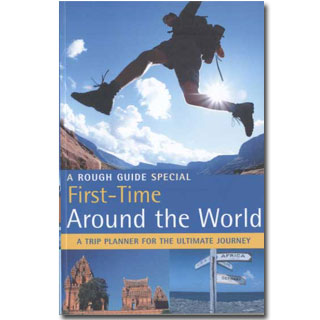
This blog is a year old today. Our first post was actually April 9, 2007 but it was Easter Monday just like today . . . so it's not exactly one year old but you know what I mean. I think I made a very brief mention of this book way back then as well. A girl named Jessica (who is a niece of someone I work with) told me it had helped her in planning her RTW trip. She and her husband are currently in South Africa and have been through much of South America, the Antartica, Australia and New Zealand. They're still travelling and, from what I hear, having the adventure of their lives (it's also their honeymoon, imagine).
Anyway, back to the book. It is called First Time Around the World but the sub-title says it all: "A trip planner for the ultimate journey". Yes, indeed. Put together by the team from the Rough Guides, this handy little paperback is (in their words) "not a travel guide, it's the book to read before you go, a planning handbook." The first edition was published in March 2003. Here's what I liked about this book:
- colour photos (got to have those)
- regional profiles and maps - the maps even have overland travel times and prices for local transport so you can do a rough calculation of some costs
- weather charts for regions so you can try to hit the best weather or at least avoid the worst - we are simply aiming not to need heavy clothing for the whole year
- info on essential gear to bring and how to pack it
- tips on planning your itinerary - and warnings about the mistake of planning too much
- the usual stuff about health and safety, insurance, visas and vaccinations
- tips on finding work abroad and/or volunteer experiences
- interesting section on foreign toilets - good to be aware of these things, in order to prepare the children of course
- potential costs/ things to consider - although this is nearly impossible to figure out. Asking "what would it cost to travel the world for a year?" is pretty much like asking "how long is a piece of string?" It really depends on alot of variables such as your comfort level with basic accommodations, where you want to go, and what kind of activities you want to do.
But the book does do a good job of costing out each region of the world across three categories: lowest and roughest (i.e., staying in the cheapest dorm hostel or camping, nights on trains, that type of thing), middle (cheap but hopefully clean hotels - I think this will be our category), and upper (decent hotel, private rooms in hostels). Within those categories, you get a rough idea of what your daily costs might look like. Obviously, staying in a cheaper country (usually a developing country) can save you a ton of money on a long trip. Hence, we will park ourselves in South-East Asia for quite a while. At least, that is the plan at this point. If we do make it to Japan (could not choose a more expensive country if we tried - it is mainly because it is Mitchell's #1 choice of place to see and that has something to do with Pokemon and Nintendo we're pretty sure), it won't be for more than a week or two even though it would be fascinating place in which to spend a long, long time.
I liked the little doses of reality injected into the book as well. This quote is an example of that:
"It's hard to pick up a travel magazine, brochure or guidebook without seeing an exotic cast of faces. The unspoken message seems to be that this is who you'll meet in these countries. The people you're far more likely to encounter, however, are other travel lers. And the local people you'll mostly come in contact with are vendors, taxi drivers, guides and hotel clerks - people serving you. To make more genuine contacts takes some effort. Volunteering or working in a place is one of the best ways. But even if you're just looking to take a picture of someone, a thoughtful approach might lead to a more meaningful connection; see p. 208 for more advice."
lers. And the local people you'll mostly come in contact with are vendors, taxi drivers, guides and hotel clerks - people serving you. To make more genuine contacts takes some effort. Volunteering or working in a place is one of the best ways. But even if you're just looking to take a picture of someone, a thoughtful approach might lead to a more meaningful connection; see p. 208 for more advice." Aha, you will have to read the book yourself to find out the advice on p. 208.
What else? There's a neat little chart found in Ch. 4 on "Costs and Savings". It's called the "Spendometer" and it judges how many days of travel you could accomplish with $1000. With $1000, you could last approximately 67 days on the road in India but only 14 in Japan. In France, it would apparently last you 20 days while you could live for 54 days in Bolivia. Australia is in the middle at 40 days. Lots of interesting little charts and calculations like this can be found in the book. As usual, though, very little about special considerations for families. I guess the people who write these travel books and guides don't think that we families get out much. Newsflash to the Rough Guides editors: you don't have to be a twenty-something, completely broke, unwashed hippie wannabe to enjoy seeing the world beyond Disney.
All in all, though, a very useful book. I will leave you with another funny travel quote I came across:
"I haven't been everywhere, but it's on my list."
Susan Sontag
Tuesday, March 18, 2008
C'est Fini

Once again, I have to say felicitations to Ted! He has passed the arduous French oral exam required for his job with the Government. After approximately 15 months of intensive, daily French language training, he is finished! Tout fini! With his "levels" in hand, he returned to work this week and could not be happier to be back. The pressure and stress of this past year has melted away and we are all feeling a little lighter . . . now if only the snow could do the same.

I know of at least one person who is still hoping for even more snow, for the sake of his "project". Check out this enormous snow tower one man in east Ottawa built . . . it now stands at 16 feet.

Sunday, March 2, 2008
Uncle Bob, Minor Hockey, and the Occasion of Our First Video Upload


We had a surprise visit from Uncle Bob! Uncle Bob is my brother from Saskatoon who was here in Ottawa briefly to attend the annual Canadian Film and Television Production Association's (CFTPA) Conference. We always have interesting conversations about this industry when he comes to visit. You can read more about his company, Angel Entertainment, or about their new TV show, Rabbit Fall, by clicking on these links.
Another interesting conversation . . . the habitual worrying that modern parents do about their children (I don't think our parents' generation worried much about us at all, why is that?)
Anyway, here is a quote shared by Bob that I found inspiring and well, I guess, a bit reassuring when I think of my one of my offspring in particular: "School is a place where former A students teach mostly B students to work for C students". Hmmm . . . rich food for thought there, no?
I was trying to find the original source of that quote and stumbled across this article from the August 2007 issue of Maclean's magazine . The author argues, citing considerable evidence, that grades don't really matter and that it is indeed the C students who end up running the world.
And lastly, youngest offspring Jackson had the thrill of the lifetime a short time ago when he and his minor hockey team-mates got to play a short scrimmage on the big ice at the Ottawa Civic Centre. It was the intermission between 2nd and 3rd period of an Ottawa 67s game against the Windsor Spitfires. The place was packed and the energy was amazing. What a great memory for him. We've never tried to upload video before but here goes . . . double-click and enjoy. Go Jackson, #23!
Friday, February 8, 2008
Book # 4 - The Travel Book

The Travel Book: A Journey Through Every Country in the World is a book put together by the folks at Lonely Planet. This book is mainly about the photos, with every country in the world given a two-page spread of glossy, gorgeous photos. The text is actually quite limited - no in-depth profiles of the countries but interesting capsules such as best time of year to visit, essential experiences, books to read and movies to watch before you go, the one word or expression in the country's native tongue that captures the heart of the place, and the trademark things to expect as well as some surprises. Here is an example of a place we are keen to spend time in - Vietnam:
Best time to visit: anytime really, but the dry season is December to April
Essential experiences: riding a motorcycle through North Vietnam's stunning high country and staying at remote hill-tribe villages; having an outfit tailor-made in the beautiful ancient city of Hoi An; floating in a boat along the Mekong
Read: The Sorrow of War by Vietnamese writer Bao Ninh
Watch: The Quiet American starring Michael Caine (set in the final days of French colonial rule and filmed throughout Vietnam)
Eat: pho (noodle soup) and banh cuon (steamed rice rolls with minced pork)
In a Word: Dep qua, phai khong! (beautiful, isn't it?)
Trademarks: postcard sellers; scooter gridlock; constant honking horns; silk shops; tailors; conical hats; rice paddies; limestone cliffs
Surprises: cold weather in North Vietnam; latest fashions have replaced the traditional dress
The 230 countries - presented in simple alphabetical order - range from Afghanistan to Zimbabwe. In putting together this book, the editors relied on the UN's list of defined countries, of which there are 192. They then added certain foreign dependencies of those countries (e.g., Bermuda, New Caledonia, the Cayman Islands, French Polynesia) because they are travel destinations in their own right. They also separately feature places like England, Scotland, and Wales - as opposed to one entry for the United Kingdom of Great Britain. Similarly, they feature places like Macau, Tibet, and Hong Kong - which are all parts of China - on their own out of respect to their historic identity rather than the current political reality. Antartica and Greenland are also not countries, according to the UN list, but because they are so strikingly photogenic and fascinating to visit, they also got their own entries in this book. Finally, Tony Wheeler and his cohorts at Lonely Planet stuck in 12 bonus destinations at the end of the book - places they say they could not bear to leave out. Curious? Here they are:
1. Ascension (UK) - home to 44 volcano craters
2. Diego Garcia - British Indian Ocean Territory
3. Gibraltor (UK)
4. Montserrat (UK)
5. Niue (island off New Zealand)
6. Saint Helena (UK) - remote island halfway between South America and Africa - famous former resident was Napoleon Bonaparte
7. Saint Pierre & Miquelon (France)
8. South Georgia (UK)
9. Svalbard (Norway)
10. Tokelau (more islands off New Zealand)
11. Tristan Da Cunha (UK) - very remote, near Saint Helena
12. Wallis & Futana (France) - French Pacific colony
So, all in all, a great coffee-table book. I don't actually own it but have renewed it probably a half-dozen times or so from the good ol' public library so it has pretty much assumed a regular spot on the coffee table in our house. Check it out if you have wanderlust!
Monday, January 21, 2008
Book #5 - Bill Bryson's African Diary

How could any list of travel books not include one by Bill Bryson? Bill Bryson's African Diary, published in 2002, is the account of his journey to Kenya with members of CARE International. This book is only about 50 pages in length - you can read it in an evening. I feel a little guilty that I borrowed it from the library, as money from the sales of the book are passed on to CARE International, a charity that has many projects in Africa (as well as other countries) that share the aim of eradicating poverty. Since Kenya is one of the countries we hope to visit - let's hope things will have calmed down completely by then - I was curious to read of his experience.
In the opening chapter, Bryson describes how he was approached by the staff of CARE International to travel with them and write about some of their projects in Kenya. Being the very funny man that he is, he starts off by exaggerating his ignorance about the country, making references to Karen Blixen and the film Out of Africa. He brings to life the slums of Nairobi, the beauty of the Great Rift Valley, and the inspiring work of CARE in the refugee camps and with various agricultural projects. It's his wry take on the danger that sometimes surrounds him that shows him at his most hilarious. Here's a funny bit from when he and the CARE staff are en route to Nairobi from London (p. 8):
"An hour or so after we are airborne, by chance I come across an article in The Economist declaring Nairobi to be the new crime capital of Africa. My attention is particularly arrested by the disclosure that street children come up to cars waiting at traffic lights demanding money and if it's not given they rub balls of human excrement in the victim's face. I share this information with my new companions and we agree that Dan, as group leader, will be our designated "rubbee" for the week. Conveniently, Dan is in the lavatory when the matter is discussed and so the motion carries unanimously. In order not to spoil his enjoyment of Nairobi, we decide not to tell him of our decision until we see children advancing."
But here's my favourite excerpt - a description of the infamous train route between Nairobi and Mombasa (p. 21):
"In the early evening we made our way to the modestly grand central railway station in Nairobi to catch the overnight sleeper to Mombasa.
Kenyan Railways has something of a tradition of killing its passengers. In just the past decade, a little over 200 people have died in accidents on its trains. The accident that seems to have attracted the most publicity in recent years was one in 1999 when the overnight Nairobi-to-Mombasa train jumped the rails at an interesting sounding place called "Man Eaters Junction" in Tsavo National Park, killing 32 people.
The crew blamed brake failure. Kenyan Railways blamed the crew. No one really knows what happened. The following year another 30-plus people were killed in two accidents, both involving runaway trains, in the space of four days. The biggest disaster of all was when a train bound for Mombasa from Nairobi plunged off a bridge and into the "crocodile-infested" Ngai Ndeithya River, killing 140 people. Ngai Ndeithya means "God help us" in Kiswahili, which would seem to be a not inappropriate motto for the railway itself. Almost since the beginning, however, the train has been known as the Lunatic Express. Can't think why."

Fortunately for all of us, Bryson survived the trip and has continued writing great travel books. And no, Nana, we won't be taking your grandchildren on the overnight sleeper from Nairobi to Mombasa. We promise.
Subscribe to:
Posts (Atom)


